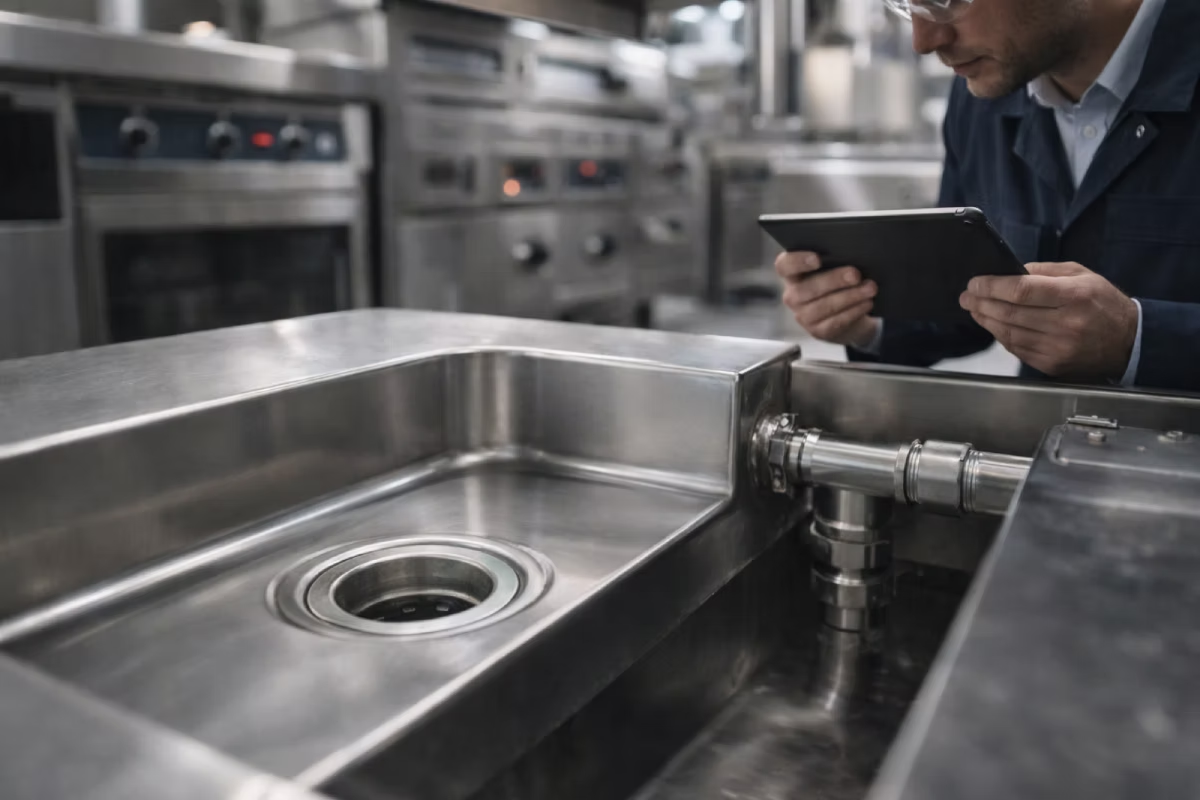
Biological Wastewater Treatment for Gastronomy & Businesses
lipasanF® is a patented microbial culture for fat degradation in wastewater systems. It may help reduce grease deposits at typical hotspots in kitchens and dishwashing areas — preventive rather than purely reactive, without added chemical agents.
Quick overview
Preventive hotspot approach: the culture is applied at a suitable dosing point and may reduce deposits and related operational issues.
Hotspot dosing: apply where grease typically accumulates.
Supports calmer operations: fewer disruptions and unplanned interventions.
Fits real-world workflows: pilot phase + dosing logic adapted to the site.
Note: Effect and timeline depend on infrastructure, grease load, temperature and dosing point. Preventive use does not replace mechanical maintenance.
Typical operational hotspots
Kitchen areas, dishwashing sections and inlets are common places where grease peaks can lead to buildup.
Grease peaks
addressed preventively
Odor (H₂S)
may decrease
Grease interceptor
may be relieved
Operations
may become more predictable
Wording is intentionally not a promise. Results vary depending on system, load and temperature.
Problem & Ursachen
Why grease buildup occurs in food service wastewater
In kitchens, dishwashing areas, and operational processes, grease peaks regularly occur. Depending on the system, load, and temperature, these can accumulate at specific points in the wastewater system.
Typical causes
Grease and oil residues from kitchen and dishwashing processes enter the wastewater.
Temperature drops cause fats to flocculate and settle.
Hotspots such as siphons, inlets, and transitions promote deposits.
Operating times, load peaks, and cleaning intervals influence the system.
Possible effects
Deposits can impair flow.
Odors (e.g., H₂S) may increase.
Maintenance and interventions become harder to schedule.
Note: The described effects depend on infrastructure, usage, grease load, and temperature. Results vary depending on the system.
Lösung
The solution: preventive biological fat degradation with lipasanF®
lipasanF® is a patented microbial culture for fat degradation. In gastronomy and businesses, it is used preventively at defined hotspots – tailored to the system, load, and operating conditions.
How it works in the system
The application takes place at the dosing point – where grease typically accumulates. The goal is to stabilize deposit zones in the wastewater system and reduce operational disruptions (depending on the system).
Hotspot approach: dosing at critical points instead of treating "everything".
Microbial fat splitting supports the breakdown of fats/oils in the system.
Without chemical additives – as a preventive supplement to operation & maintenance.
How we start (pilot phase)
FFor businesses, a short pilot phase is often used to fine-tune the dosing point, application logic, and accompanying parameters.
2
Define dosing point & set application logic (load, times, temperature).
3
Accompany pilot phase: observation, documentation, fine-tuning.
4
Derive recommendation: routine operation, make maintenance more predictable.
Note: Procedure and duration are adapted to infrastructure, grease load, and temperature.
Why businesses switch
Instead of acting exclusively reactively (e.g., in case of disruptions), prevention is integrated into the process – with clear dosing logic and documentable support.
Smoother daily operations through preventive hotspot control.
Odors (e.g., H₂S) may decrease depending on the system.
Compatible with typical kitchen workflows and grease separators.
Phrasings are deliberately not meant as promises. Effectiveness and time course depend, among other things, on infrastructure, grease load, temperature, and dosing point. Results vary depending on the system.
Einsatzszenarien
Typical use scenarios in the operation
Depending on kitchen workflows, grease load, and infrastructure, hotspots vary. The following examples show typical use cases – the specific dosing logic is tailored to the operation.
KKitchen & Dishwashing Area
Hotspots at inlets, siphons, and transitions
In heavily frequented areas, fat peaks can lead to deposits at typical bottlenecks. Here, a dosing point is often chosen so that the application acts preventively.
Application where fat typically accumulates (hotspot approach).
Effectiveness can be better during times of low water flow.
Integration into existing processes without additional chemical additives.
Note: Implementation and effectiveness depend on the system, load, and temperature.
Grease Separator
Relief and more stable operating conditions
In operations with grease separators, stabilizing conditions is often the focus. Dosing point and interval are chosen so that operation becomes more predictable.
Dosing logic is oriented towards peak loads and operating times.
Odor (e.g., H₂S) may decrease depending on the system.
Documentable pilot phase to coordinate intervals.
Note: Implementation and effectiveness depend on the system, load, and temperature.
Multiple Locations / Chains
Standardization with location-specific fine-tuning
For multiple kitchens, a repeatable approach is helpful. At the same time, infrastructure and temperature are considered for each location to configure the application appropriately.
Same mode of action, adjusted dosing points per location.
Pilot phase as a "template" for rollout decisions.
Maintenance and service visits can become more predictable.
Note: Implementation and effectiveness depend on the system, load, and temperature.
This is how we derive the appropriate dosing logic
We jointly consider hotspots, grease load, operating times, and temperature. From this, a dosing recommendation (pilot phase) is derived – tailored to infrastructure and objectives.
Practice videos: This is how it works in operation
The videos show typical processes in kitchen and operational environments: identifying hotspots, setting dosing points, and practically classifying the application — without marketing promises.
Subtitles: Select language in the player (if available).
Andy introduces himself (Practice & Hotspots)
Practice
Classification from everyday operations: Where grease hotspots occur, why they are problematic, and why prevention in the operation makes sense.
What you see in the video
Typical grease hotspots in kitchen and dishwashing areas (inlets, siphons, transitions).
Influence of operating times, peak loads, and temperature on deposits.
Basics for selecting dosing point and pilot phase in operation.
Show transcript / key statements
Hello dear colleagues, I am Andreas. We run a canteen business in Frankfurt-Rödelheim. Beforehand, I would like to get something going. For this video, I don`t get any money nor do I have economic interests in it. But if something is good, I would like to do it in the first place. And it`s about lipasanF®. It is a medium that works on biological paths and prevents the fat deposits in the pipes from the sink to the grease separator and also the fat deposits in the grease separator. I`ve been doing this for 30 years now and I`ve had some representatives in the kitchen who told me they had the miracle remedy with them. But it was nothing but nonsense. lipasanF® is different. It really helps. I was allowed to get to know the remedy after my drain was completely clogged again. And of course that always happens when you can`t use it. The place is full, the drain doesn`t run. We had to mechanically clean the drain. In the kitchen without water is a real problem. The dishwasher didn`t work, so real trouble, real stress. After these actions, we used lipasanF® and it really helps. I can`t say otherwise. We`ve been using it for about a year now and haven`t had any problems for a year now. We cleaned the grease separator three to four times a year. I`ve had it done once now. The pipes from the sink to the grease separator are fat-free. The use of lipasanF® is really completely free of problems. I`ll show you what we do right away. We dose about 100 to 200 milliliters into the sink once a Friday and that`s it. We`ll go into the kitchen together afterwards. I`ll show you how to do that and maybe we`ll take a look at the grease separator again.
Andy Tutorial: Application & Dosing Logic
Practice
Practical procedure for application: preparing dosing amount, setting dosing points, and accompanying use in operation.
What you see in the video
Preparation of dosing and distribution to multiple drains.
Notes on application in everyday operations (timing, exposure phase).
What to watch out for in handling (e.g., no chemical additives like chlorine).
Show transcript / key statements
So, as promised, do the dosage once. This is purely a matter of experience from me. I take about between 100 and 200 milliliters of the product and fill it up with water. So, that was all the work you have to do. Then there is about a third in every drain. So, as I said, something comes in every drain. You`ll have that in the drain soon. Over here we still have the sink. That also comes in here. So, that`s it. The best thing to do is to do it on a day when the gas station is closed on the following day, so that it can work properly in the middle. Finally, just let the water run again so that the product does not stand in the faucet. Very important thing. So, now another very important thing for you. Each of you has chlorine in the kitchen, you have to let go of that. Chlorine is the only thing that harms the product. So, if you use the lipasanF®, let go of the chlorine. Both things do not tolerate each other. So, then one more thing that is probably important for you. Last year, a sample was taken from the grease machine and we did not have to pay a fine for it for the first time in years. Normally, a sample is always taken and then the liquids are too high. That`s about 150, 180 euros. This fine has been removed. So, another important argument to apply the product. So, the case has arrived at the site. I would now like to explain to you what is going on in the grease machine. So, when we did not use the product yet, there was a layer of grease of about 25, 30 centimeters on the water. This is no longer the case. The thing here is perfect and as you can see, also slightly creamy. Of course, how you can all smell clearly, you do not smell anything. So, also the odor pollution disappears. That is a very big advantage. It does not smell anymore. Even if it is pumped once a year, the neighbors do not fall out of the garden house. It is really odor neutral here.
Canteen operation during holidays (Practice)
Practice
Practical insight from canteen operations: How drains respond after extended downtime and what to consider when restarting.
What you see in the video
Operation pause over several days without using the kitchen.
Observation of drain behavior after resuming operation.
Assessment of the experience from the perspective of ongoing operations.
Show transcript / key statements
Hello, here is Andi again. I wanted to share our experience with you about lipasanF®, how the product behaves while the canteen is closed. We had 14 days off during the holidays. Normally, when we come back, the grease has solidified in the pipes so that no water runs anymore. That means we have to clean the pipes mechanically first. It costs between 180 and 250 euros. This year was the first time that we used lipasanF® during the holidays. And, what should I tell you, the drain was running. There was no problem at all. So, the only one who worked here in the company is lipasanF®, even during the holidays. lipasanF®, thumbs up!
Would you like to transfer this to your operation?
We clarify hotspots and framework conditions and derive a suitable pilot phase/dosing logic — tailored to infrastructure, grease load, and operating times.
The application is integrated into the process through an appropriate dosing point. Dosing logic and intervals are based on hotspots, grease load, operating times, and temperature – often through a short pilot phase.
Dosing Point
Where is dosing applied?
It is not about "more" but "right": The dosing point is chosen where fat typically accumulates or where hotspots form.
Typical locations: inlets, siphons, transitions, areas near separators.
Goal: act preventively – before deposits become operationally relevant.
Selection depends on pipe routing, usage, and accessibility.
Application
How is the application carried out?
The application can be manual or via dosing technology. What matters is a reproducible process that fits into operations.
3
Accompany pilot phase: observe, document, fine-tune.
4
Derive routine: set interval and amount specific to location.
Note: Specific intervals/amounts are adjusted depending on the system.
Operation
Parameters Influencing the Process
To ensure the application is effective, operational conditions are taken into account. This helps set realistic expectations and stabilize implementation.
Temperature, grease load, and water flow influence the process.
Consider cleaning regimes and chemical use (if applicable).
Infrastructure and accessibility determine practical implementation.
Phrasings are deliberately not meant as promises. Implementation and course depend, among other things, on infrastructure, grease load, temperature, cleaning regime, and dosing point. Results vary depending on the system.
Pilot phase instead of gut feeling
We coordinate dosing point and application logic in a pilot phase. This creates a comprehensible recommendation – tailored to operation, infrastructure, and objectives.
Kurzantworten für den Betrieb: kompatibel, planbar, ohne chemische Zusätze. Details klären wir in der Pilotphase anhand Ihrer Anlage.
How does biological fat splitting work?
The microorganisms in lipasanF® break down fats and oils in wastewater into easily degradable components, reducing deposits and odors.
What are the benefits of lipasanF® for my business?
It helps prevent blockages, reduce odors, lower maintenance costs, and increase operational safety.
Is lipasanF® safe for my wastewater systems?
Yes, it is environmentally friendly and gentle on materials, as it does not use aggressive chemicals.
How is lipasanF® applied?
It is delivered ready to use and can be dosed manually or automatically, depending on the needs of your operation.
How does biological wastewater treatment with lipasanF® work?
lipasanF® contains microorganisms that break down fats and oils (triglycerides) into easily degradable components. This reduces deposits and H₂S odors; the operation becomes more stable.
For which areas is lipasanF® particularly suitable?
For gastronomy, food businesses, large kitchens, municipal and industrial wastewater treatment – everywhere fat enters the wastewater.
How is it dosed?
Practical recommendation: diluted 1:10 to 1:15, introduced manually before or via dosing pump during idle times into the affected drains. The exact amount is determined on a site-specific basis.
How quickly do effects occur?
Initial relief is often noticeable after days; significant improvements typically after a few weeks – depending on fat load, pipe geometry, and operating mode.
How is lipasanF® stored?
Store in a dry place at +5 to +12 °C. Shelf life up to 6 months. Use between +5 and +30 °C without loss of activity is possible.
What evidence is available?
Practical reports and videos: including Amperverband (25 m³ hardened fat split), references from Rheinberg (LINEG NRW) and Pfungstadt.
Verträgt sich lipasanF® mit dem Fettabscheider?
Ja. In der Praxis wird der Dosierpunkt so gewählt, dass Fett-Hotspots im Zulauf/Leitungssystem präventiv entlastet werden. Auslegung und Positionierung richten sich nach Leitungsführung, Last und Betriebszeiten.
Wie schnell merkt man Effekte im Küchenablauf?
Typisch sind erste Veränderungen bei Geruch und Durchfluss nach kurzer Zeit – die stabile Wirkung baut sich je nach Last, Temperatur und Nutzung über Wochen auf.
Brauchen wir Umbauten oder Stillstand?
In der Regel nicht. Je nach Situation reicht eine manuelle Dosierung oder eine kompakte Dosierlösung – ohne größere bauliche Eingriffe. Das Setup erfolgt im laufenden Betrieb so schonend wie möglich.
Ist das „Chemie“ oder aggressiv zu Material/Dichtungen?
lipasanF® arbeitet mikrobiell (Keimkultur) und wird ohne chemische Zusätze eingesetzt. Materialverträglichkeit hängt vom System ab – deshalb prüfen wir Dosierung und Dosierpunkt in der Pilotphase.
Wie läuft die Dosierung in der Gastronomie ab?
Wir definieren Hotspots und Dosierpunkte, legen die Startdosierung fest und passen nach Beobachtung an (z. B. Küchenbetrieb, Wochenenden, Temperatur). Ziel ist ein ruhiger, planbarer Regelbetrieb.
Hinweis: Ergebnisse variieren je nach Anlage, Last und Temperatur.
{"title":"Biological Wastewater Treatment for Gastronomy | lipasanF®","description":"Microbial, environmentally friendly fat splitting for gastronomy, food industry, and municipal businesses – with practical references.","canonical":"https://lipobak.de/en/biological-wastewater-treatment","alternates":[{"lang":"de","href":"https://lipobak.de/de/biologische-abwasseraufbereitung"},{"lang":"en","href":"https://lipobak.de/en/biological-wastewater-treatment"},{"lang":"x-default","href":"https://lipobak.de/de/biologische-abwasseraufbereitung"}],"jsonld":[{"@type":"Service","@id":"https://lipobak.de/en/biological-wastewater-treatment#service","name":"Biological Wastewater Treatment for Gastronomy \u0026 Businesses","serviceType":"Biological fat splitting in gastronomy \u0026 large kitchens","description":"Microbial, environmentally friendly fat splitting for gastronomy, food industry, and municipal businesses – with practical references.","provider":{"@id":"https://lipobak.de/#business"},"mainEntityOfPage":{"@id":"https://lipobak.de/en/biological-wastewater-treatment#webpage"},"areaServed":{"@type":"AdministrativeArea","name":"European Union"}},{"@type":"BreadcrumbList","@id":"https://lipobak.de/en/biological-wastewater-treatment#breadcrumb","itemListElement":[{"@type":"ListItem","position":1,"name":"Home","item":"https://lipobak.de/en"},{"@type":"ListItem","position":2,"name":"Biological Wastewater Treatment for Gastronomy | lipasanF®","item":"https://lipobak.de/en/biological-wastewater-treatment"}]},{"@type":"VideoObject","@id":"https://lipobak.de/en/biological-wastewater-treatment#video1","name":"Andy introduces himself (Practice \u0026 Hotspots)","description":"Classification from everyday operations: Where grease hotspots occur, why they are problematic, and why prevention in the operation makes sense.","thumbnailUrl":"https://lipobak.de/assets/images/gastro/videos/andy-intro-poster.jpg","contentUrl":"https://lipobak.de/assets/videos/gastro/andy-stellt-sich-vor/andy-stellt-sich-vor.mp4","uploadDate":"2024-08-01","duration":"PT2M07S","inLanguage":"en","publisher":{"@id":"https://lipobak.de/#business"},"mainEntityOfPage":{"@id":"https://lipobak.de/en/biological-wastewater-treatment#webpage"}},{"@type":"VideoObject","@id":"https://lipobak.de/en/biological-wastewater-treatment#video2","name":"Andy Tutorial: Application \u0026 Dosing Logic","description":"Practical procedure for application: preparing dosing amount, setting dosing points, and accompanying use in operation.","thumbnailUrl":"https://lipobak.de/assets/images/gastro/videos/andy-tutorial-poster.jpg","contentUrl":"https://lipobak.de/assets/videos/gastro/andy-tutorial/andy-tutorial.mp4","uploadDate":"2024-08-01","duration":"PT2M49S","inLanguage":"en","publisher":{"@id":"https://lipobak.de/#business"},"mainEntityOfPage":{"@id":"https://lipobak.de/en/biological-wastewater-treatment#webpage"}},{"@type":"VideoObject","@id":"https://lipobak.de/en/biological-wastewater-treatment#video3","name":"Canteen operation during holidays (Practice)","description":"Practical insight from canteen operations: How drains respond after extended downtime and what to consider when restarting.","thumbnailUrl":"https://lipobak.de/assets/images/gastro/videos/andy-feiertage-poster.jpg","contentUrl":"https://lipobak.de/assets/videos/gastro/andy-an-feiertagen/kantinenbetrieb-ueber-die-feiertage.mp4","uploadDate":"2024-08-01","duration":"PT0M50S","inLanguage":"en","publisher":{"@id":"https://lipobak.de/#business"},"mainEntityOfPage":{"@id":"https://lipobak.de/en/biological-wastewater-treatment#webpage"}},{"@type":"ItemList","@id":"https://lipobak.de/en/biological-wastewater-treatment#videos","name":"Videos","itemListOrder":"https://schema.org/ItemListOrderAscending","numberOfItems":3,"itemListElement":[{"@type":"ListItem","position":1,"item":{"@id":"https://lipobak.de/en/biological-wastewater-treatment#video1"}},{"@type":"ListItem","position":2,"item":{"@id":"https://lipobak.de/en/biological-wastewater-treatment#video2"}},{"@type":"ListItem","position":3,"item":{"@id":"https://lipobak.de/en/biological-wastewater-treatment#video3"}}]},{"@type":"FAQPage","@id":"https://lipobak.de/en/biological-wastewater-treatment#faq","inLanguage":"en","mainEntity":[{"@type":"Question","name":"How does biological fat splitting work?","acceptedAnswer":{"@type":"Answer","text":"The microorganisms in lipasanF® break down fats and oils in wastewater into easily degradable components, reducing deposits and odors."}},{"@type":"Question","name":"What are the benefits of lipasanF® for my business?","acceptedAnswer":{"@type":"Answer","text":"It helps prevent blockages, reduce odors, lower maintenance costs, and increase operational safety."}},{"@type":"Question","name":"Is lipasanF® safe for my wastewater systems?","acceptedAnswer":{"@type":"Answer","text":"Yes, it is environmentally friendly and gentle on materials, as it does not use aggressive chemicals."}},{"@type":"Question","name":"How is lipasanF® applied?","acceptedAnswer":{"@type":"Answer","text":"It is delivered ready to use and can be dosed manually or automatically, depending on the needs of your operation."}},{"@type":"Question","name":"How does biological wastewater treatment with lipasanF® work?","acceptedAnswer":{"@type":"Answer","text":"lipasanF® contains microorganisms that break down fats and oils (triglycerides) into easily degradable components. This reduces deposits and H₂S odors; the operation becomes more stable."}},{"@type":"Question","name":"For which areas is lipasanF® particularly suitable?","acceptedAnswer":{"@type":"Answer","text":"For gastronomy, food businesses, large kitchens, municipal and industrial wastewater treatment – everywhere fat enters the wastewater."}},{"@type":"Question","name":"How is it dosed?","acceptedAnswer":{"@type":"Answer","text":"Practical recommendation: diluted 1:10 to 1:15, introduced manually before or via dosing pump during idle times into the affected drains. The exact amount is determined on a site-specific basis."}},{"@type":"Question","name":"How quickly do effects occur?","acceptedAnswer":{"@type":"Answer","text":"Initial relief is often noticeable after days; significant improvements typically after a few weeks – depending on fat load, pipe geometry, and operating mode."}},{"@type":"Question","name":"How is lipasanF® stored?","acceptedAnswer":{"@type":"Answer","text":"Store in a dry place at +5 to +12 °C. Shelf life up to 6 months. Use between +5 and +30 °C without loss of activity is possible."}},{"@type":"Question","name":"What evidence is available?","acceptedAnswer":{"@type":"Answer","text":"Practical reports and videos: including Amperverband (25 m³ hardened fat split), references from Rheinberg (LINEG NRW) and Pfungstadt."}}],"isPartOf":{"@id":"https://lipobak.de/en/biological-wastewater-treatment#webpage"}},{"@type":["WebPage"],"@id":"https://lipobak.de/en/biological-wastewater-treatment#webpage","name":"Biological Wastewater Treatment for Gastronomy | lipasanF®","url":"https://lipobak.de/en/biological-wastewater-treatment","inLanguage":"en","description":"Microbial, environmentally friendly fat splitting for gastronomy, food industry, and municipal businesses – with practical references.","isPartOf":{"@id":"https://lipobak.de/#website"},"publisher":{"@id":"https://lipobak.de/#business"},"about":{"@id":"https://lipobak.de/en/biological-wastewater-treatment#service"},"hasPart":[{"@id":"https://lipobak.de/en/biological-wastewater-treatment#video1"},{"@id":"https://lipobak.de/en/biological-wastewater-treatment#video2"},{"@id":"https://lipobak.de/en/biological-wastewater-treatment#video3"},{"@id":"https://lipobak.de/en/biological-wastewater-treatment#faq"}],"mainEntity":{"@id":"https://lipobak.de/en/biological-wastewater-treatment#videos"},"breadcrumb":{"@id":"https://lipobak.de/en/biological-wastewater-treatment#breadcrumb"}}]}